


For Southeast Asian industrial parks, the question is not simply whether solar looks greener or grid power looks cheaper. Buyers comparing solar vs grid LED street lights should start with road use, power access, operating hours, maintenance capability, and how much lighting risk the site can tolerate.
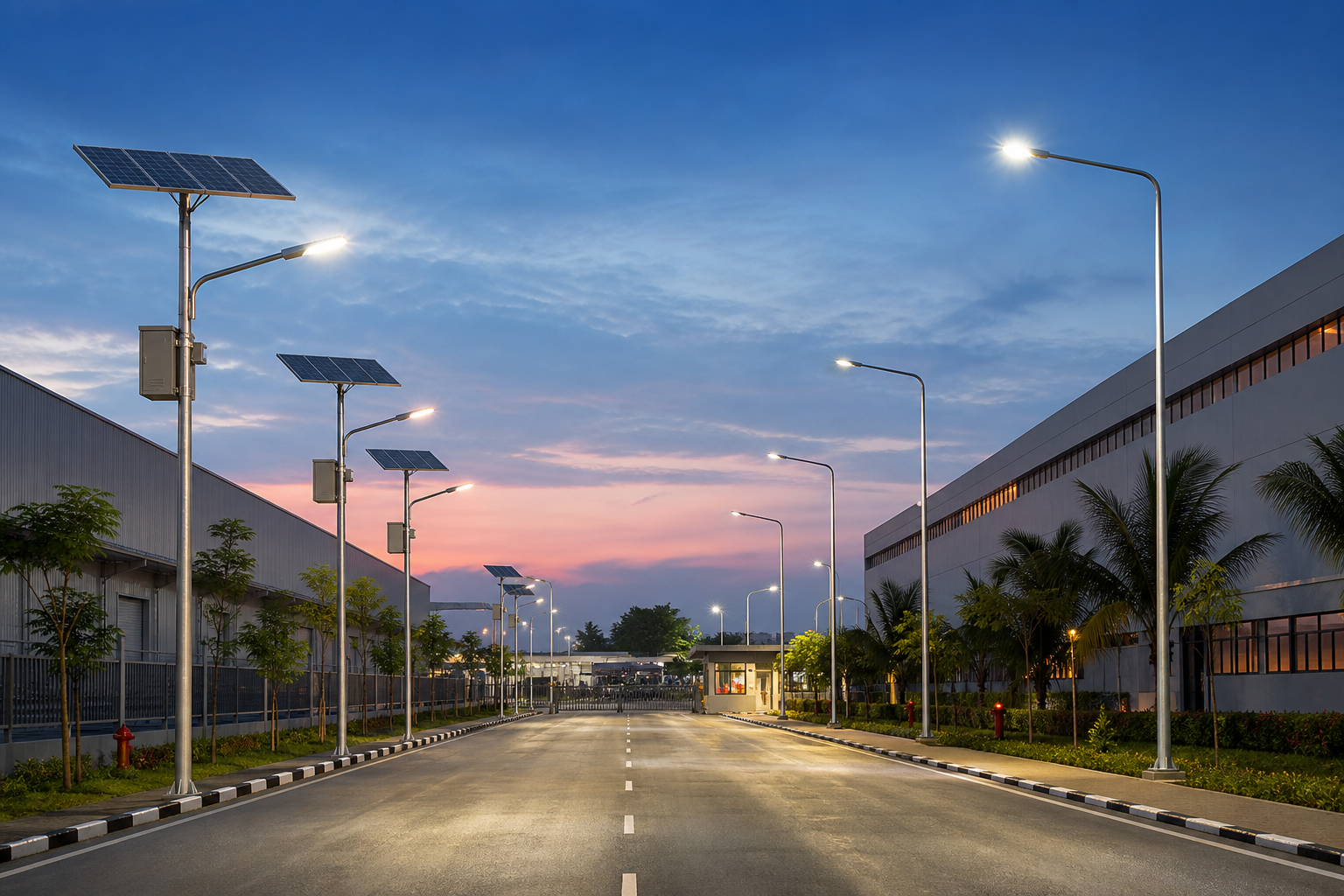
The International Energy Agency's Southeast Asia Energy Outlook 2026 says electricity demand in the region is growing twice as fast as overall energy use. For factories, logistics parks, and export zones, that makes exterior lighting part of a wider infrastructure decision: every new road, checkpoint, warehouse apron, and perimeter lane adds long operating hours.
Solar street lights can reduce trenching and utility coordination where roads are remote or still under development. Grid-connected LED street lights can be easier to centralize, meter, and maintain where reliable power distribution already exists. Neither option is automatically correct for every industrial road.
Solar is worth serious review for new roads, temporary construction phases, security routes, parking overflow, coastal sites with difficult trenching, or areas where power extension would delay the project. It can also help when the owner wants lighting before the final electrical network is complete.
Ask suppliers to define the solar panel size, battery chemistry, usable battery capacity, controller logic, dimming schedule, seasonal assumptions, and autonomy basis. Avoid accepting a runtime claim unless it explains the local solar resource, shading, fixture output, and low-sun design condition.
Grid-connected LED street lights are often stronger for high-traffic main roads, heavy truck gates, inspection lanes, container yards, and areas that need consistent full-night output. They may also fit better when the industrial park already has underground power, central maintenance teams, existing lighting control standards, or strict monitoring requirements.
The U.S. Department of Energy's exterior lighting procurement guidance emphasizes energy-efficient luminaires, performance data, and automatic controls. Those principles apply beyond public procurement: industrial buyers should compare efficacy, optical distribution, controls, reliability data, and installation requirements rather than fixture wattage alone.
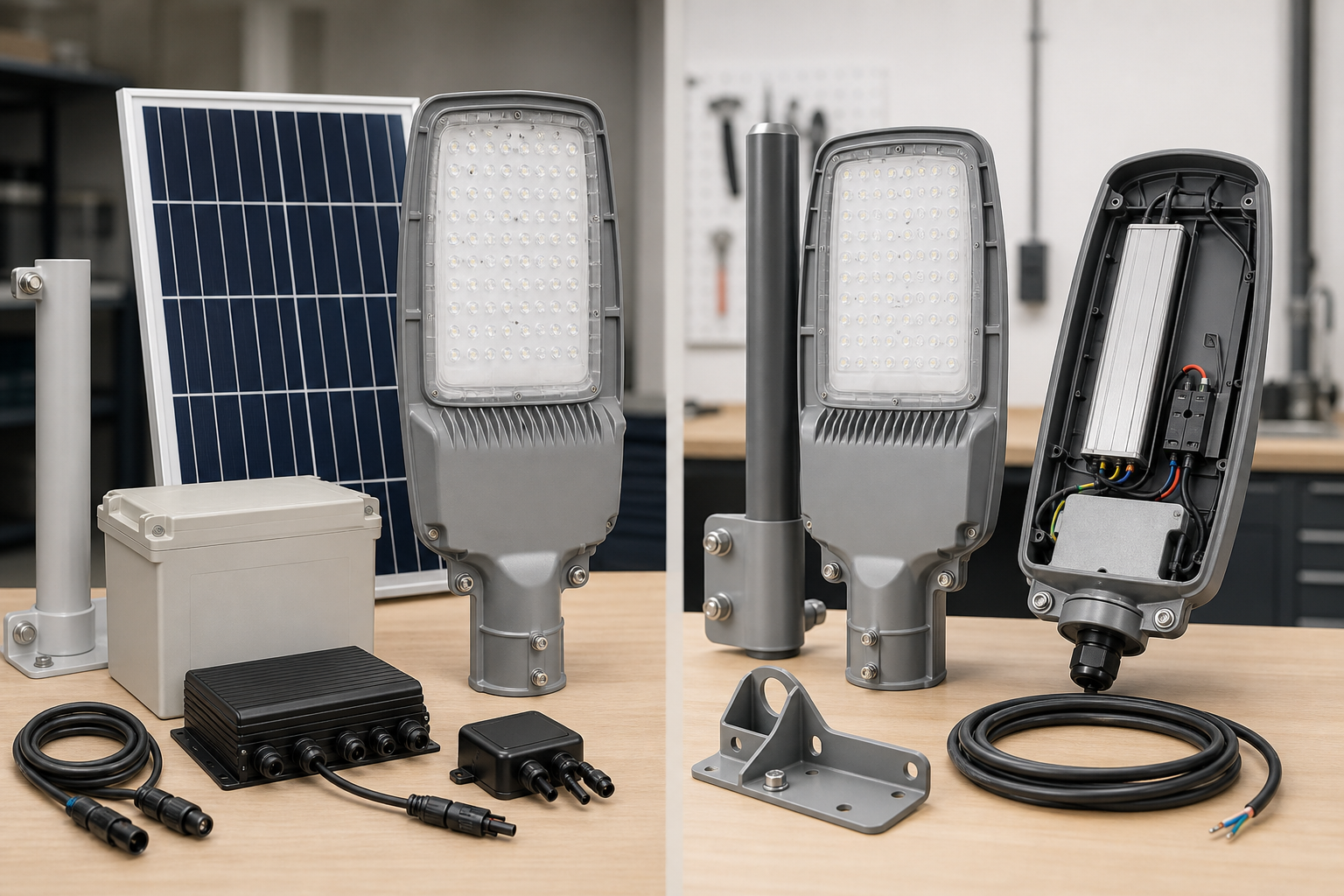
For both solar and grid systems, request a photometric layout based on the actual road width, pole height, spacing, setback, mounting arm, fixture distribution, and maintained output. The layout should separate main roads, pedestrian paths, parking lanes, guard posts, loading aprons, and perimeter roads.
DarkSky's responsible outdoor lighting principles are a practical checklist: light should be useful, targeted, no brighter than necessary, controlled, and warmer-colored where possible. For industrial parks, that translates into correct optics, careful aiming, shielding near boundaries, time schedules, and dimming rather than blanket high output everywhere.
No. Solar may reduce trenching and electrical work, but it adds panels, batteries, controllers, and battery maintenance. Compare total installed and lifecycle costs.
Yes. A mixed design is often practical: grid lighting for main roads and gates, solar lighting for remote lanes or phased development areas.
No. Compare maintained lighting results, optical distribution, uniformity, glare control, controls, installation cost, and service access before using wattage as a secondary reference.
Send Guangzhou Vantone Science & Technology Co., Ltd. your industrial park layout, road widths, pole plan, operating schedule, power-access status, shading conditions, and lighting priorities. The Vantone Lighting Team can help prepare a solar-versus-grid comparison checklist for project discussion.
Sources: IEA Southeast Asia Energy Outlook 2026 executive summary; U.S. DOE exterior lighting procurement guidance; DarkSky responsible outdoor lighting principles; IEA Renewables 2025 renewable electricity analysis.
