


For U.S. facility managers, electrical contractors, developers, schools, warehouses, and municipal buyers, commercial solar parking lot lights can be a practical option when a site needs outdoor illumination without extending grid power across new pavement. The purchasing decision, however, should be based on a complete lighting and energy design鈥攏ot on an advertised wattage alone.
This guide explains how to compare off-grid systems for commercial lots, overflow parking, distribution centers, campuses, storage facilities, private access lanes, and remote public sites. It also shows what information a buyer should provide before requesting a quotation.
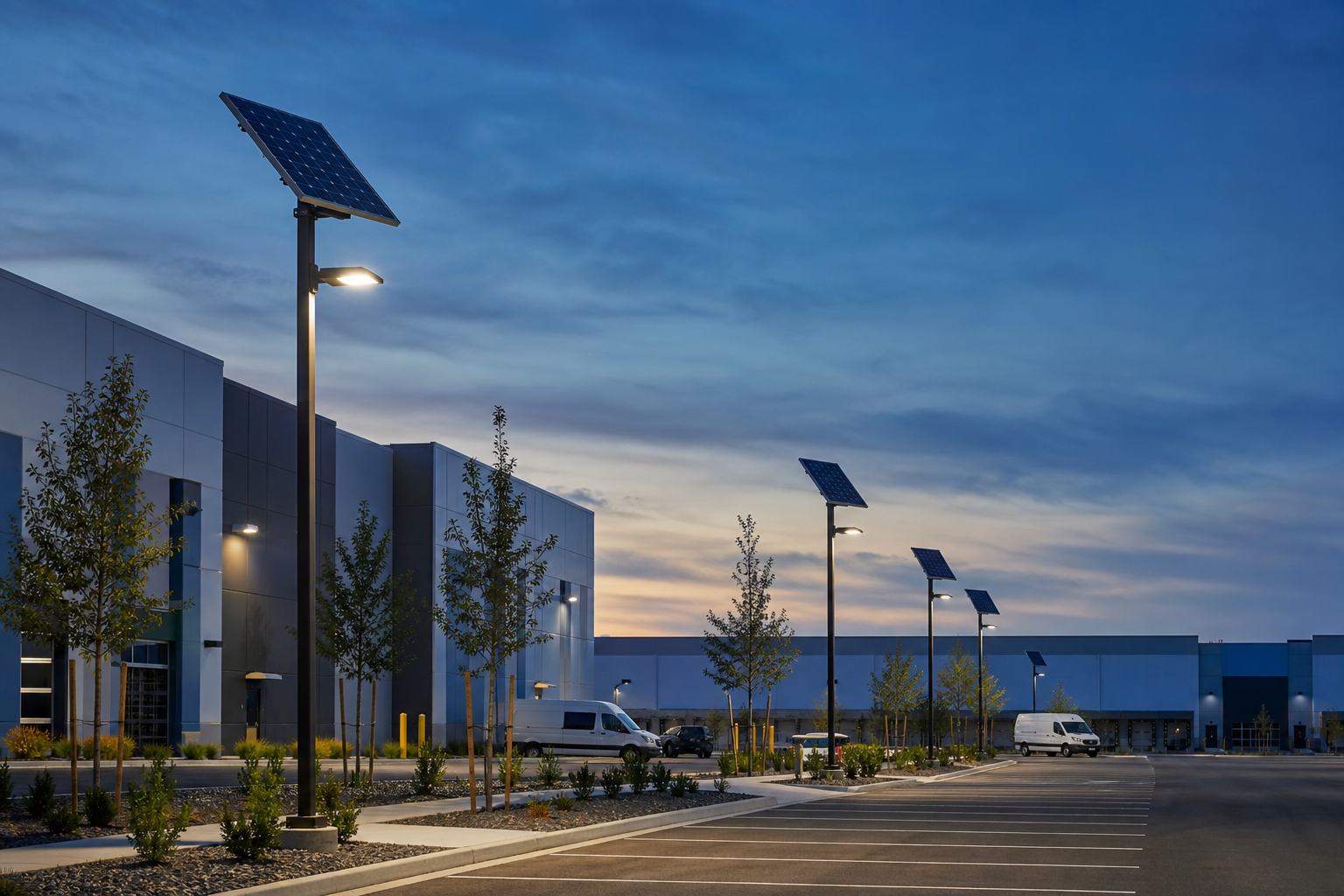
Search results for the U.S. market consistently use phrases such as solar parking lot lights with pole, off-grid parking lot lighting, and solar LED parking lot lights. These terms reflect the real procurement problem: buyers are looking for a complete outdoor system that combines an LED luminaire, photovoltaic module, battery, controller, mounting hardware, and often a pole.
Solar lighting is especially worth evaluating where trenching, conduit, utility coordination, or pavement restoration would be disruptive. It is not automatically the best answer for every lot. A shaded property, a demanding overnight schedule, a cold-climate site, or a project with strict local lighting requirements may need a larger energy system, a hybrid approach, or conventional grid-connected lighting.
A professional comparison begins with the site rather than a product page. Send a dimensioned plan showing parking rows, drive lanes, entrances, pedestrian paths, loading areas, existing poles, nearby buildings, landscaping, and property lines. Identify which areas operate all night and which only need light during business hours.
The U.S. Department of Transportation's roadway lighting resources point buyers and designers to current practices for roadway and parking-facility lighting. Uniformity, glare, mounting geometry, and maintained performance belong in the review alongside illumination levels. Ask each bidder for a parking lot photometric layout using the proposed fixture's actual photometric file, pole height, tilt, and spacing.
Two identical fixtures can require different panels, batteries, or operating profiles in Arizona and Washington. The design should account for local solar resource, seasonal day length, shading, temperature, system losses, the nightly load, and the number of low-sun days the owner expects the system to support.
The National Laboratory of the Rockies publishes the current PVWatts documentation for estimating photovoltaic energy production from location-based inputs. PVWatts is designed for grid-connected PV analysis, so it is not a substitute for off-grid battery sizing. It is still a useful reminder that credible solar planning depends on location and weather data rather than a universal runtime claim.
For every proposed system, request the panel rating, battery chemistry and usable capacity, controller logic, low-temperature or high-temperature limits, charging assumptions, and the exact nightly lighting profile. A claim such as 鈥渄usk to dawn鈥?is incomplete unless the output schedule and design conditions are defined.
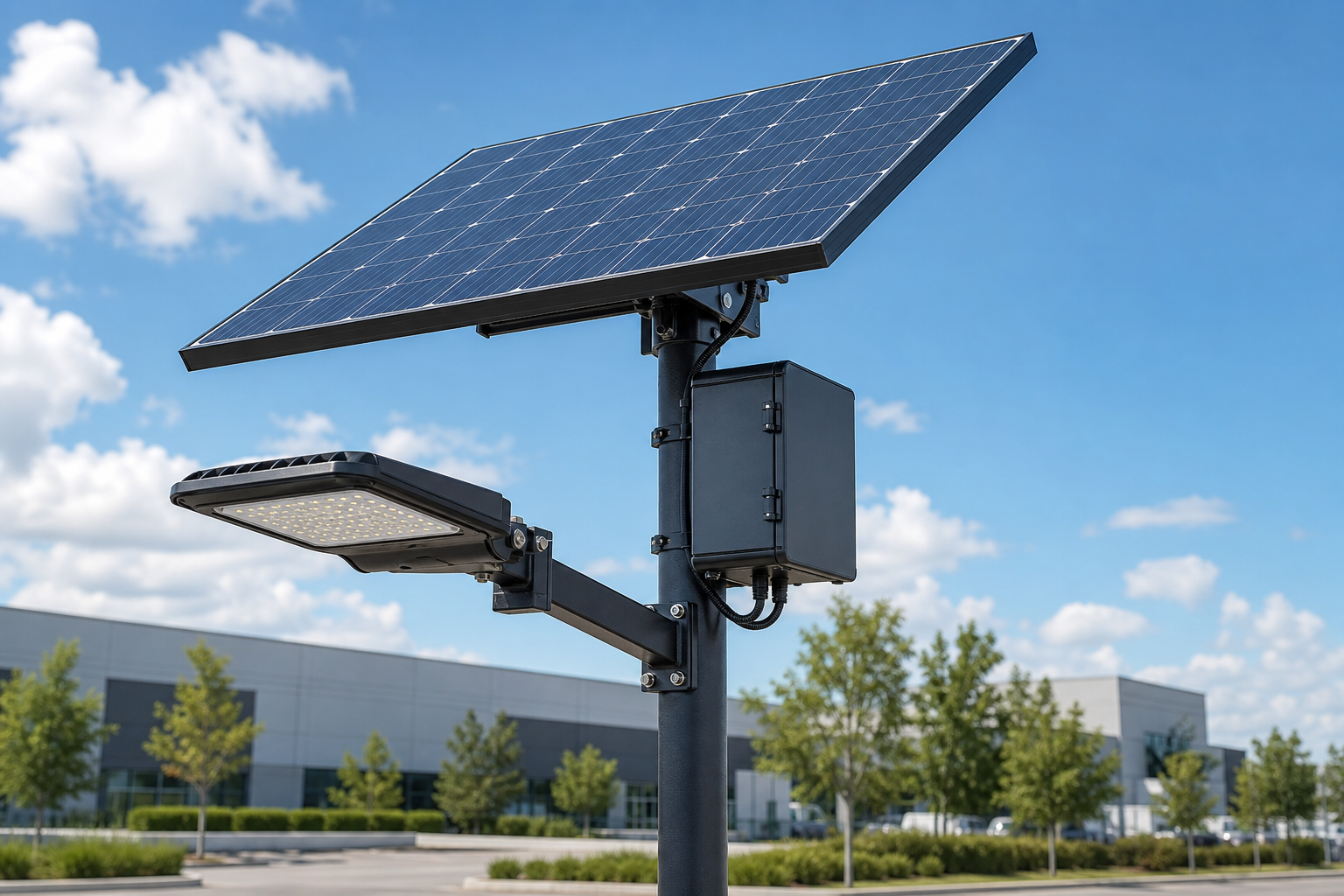
Dusk-to-dawn solar parking lot lights do not need to run at full output every minute of the night. A facility may need higher output during arrivals and shift changes, then a reduced level during low-traffic hours, with motion response in selected zones. The control profile must still preserve required visibility and uniformity.
The Department of Energy's exterior-lighting purchasing guidance emphasizes collecting accurate performance and reliability data and notes the value of automatic controls. Specify the schedule in the purchase documents so every supplier sizes the system against the same load.
Parking-lot lighting affects drivers, pedestrians, neighbors, and the night environment. DarkSky and the Illuminating Engineering Society describe responsible outdoor lighting as useful, targeted, no brighter than necessary, controlled, and warmer-colored where possible. Their Five Principles for Responsible Outdoor Lighting provide a clear framework for reviewing perimeter optics, shielding, aiming, dimming, and operating hours.
Ask the designer to show what happens at property lines and nearby windows, not only at the center of the parking area. The lowest compliant tilt, appropriate distribution, shielding where needed, and careful pole placement can reduce glare and spill light without sacrificing useful coverage.
When sourcing solar parking lot lights with pole, treat the pole and foundation as engineered site components. Provide the project location, proposed mounting height, panel area and orientation, soil or foundation information, and applicable wind, snow, and local structural requirements to the responsible project professionals.
For the luminaire and energy enclosure, compare ingress protection, corrosion protection, fasteners, cable entries, thermal design, access for battery replacement, and replacement-part availability. Do not assume a generic 鈥渃ommercial grade鈥?label proves suitability for a particular site. Request product-specific documents and confirm required listings or approvals with the local authority and project team.
Compare bids line by line. A lower fixture price may not be the lower project cost if the proposal omits poles, foundations, controls, batteries, layout support, freight protection, or replacement components.
No. Suitability depends on solar exposure, seasonal weather, shading, temperature, operating hours, required lighting performance, structural conditions, and local rules. The system should be sized for the specific site.
The layout is more useful for project decisions. Wattage describes electrical input, while the photometric design evaluates how the selected optics, output, height, spacing, and aiming perform across the site.
Either approach can work, but compatibility must be verified. A complete package can simplify coordination, while an existing-pole retrofit requires confirmation of mounting, structural capacity, panel exposure, wiring, and service access.
Send the site plan, project location, operating schedule, target performance, pole constraints, nearby sensitive areas, local requirements, desired controls, delivery destination, and project timeline.
Guangzhou Vantone Science & Technology Co., Ltd. supplies solar street light, solar LED street light, outdoor LED sports lighting, anti-glare court light, IP65 waterproof outdoor lights, and factory-direct LED lighting. For a U.S. commercial parking project, share the site plan and operating requirements to request a system recommendation and preliminary layout discussion.
