


U.S. RV resorts and campgrounds need enough nighttime visibility for internal roads, restroom routes, arrival areas, and staff operations, but guests also expect darkness, quiet, and a clear view of the night sky. Solar street lights for RV parks can support both goals when the system is designed around actual tasks instead of lighting the entire property at one uniform level.
This B2B guide is for campground owners, RV park operators, hospitality developers, electrical contractors, and purchasing teams comparing commercial solar lighting for new sites, expansions, remote loops, and areas where trenching would be difficult.
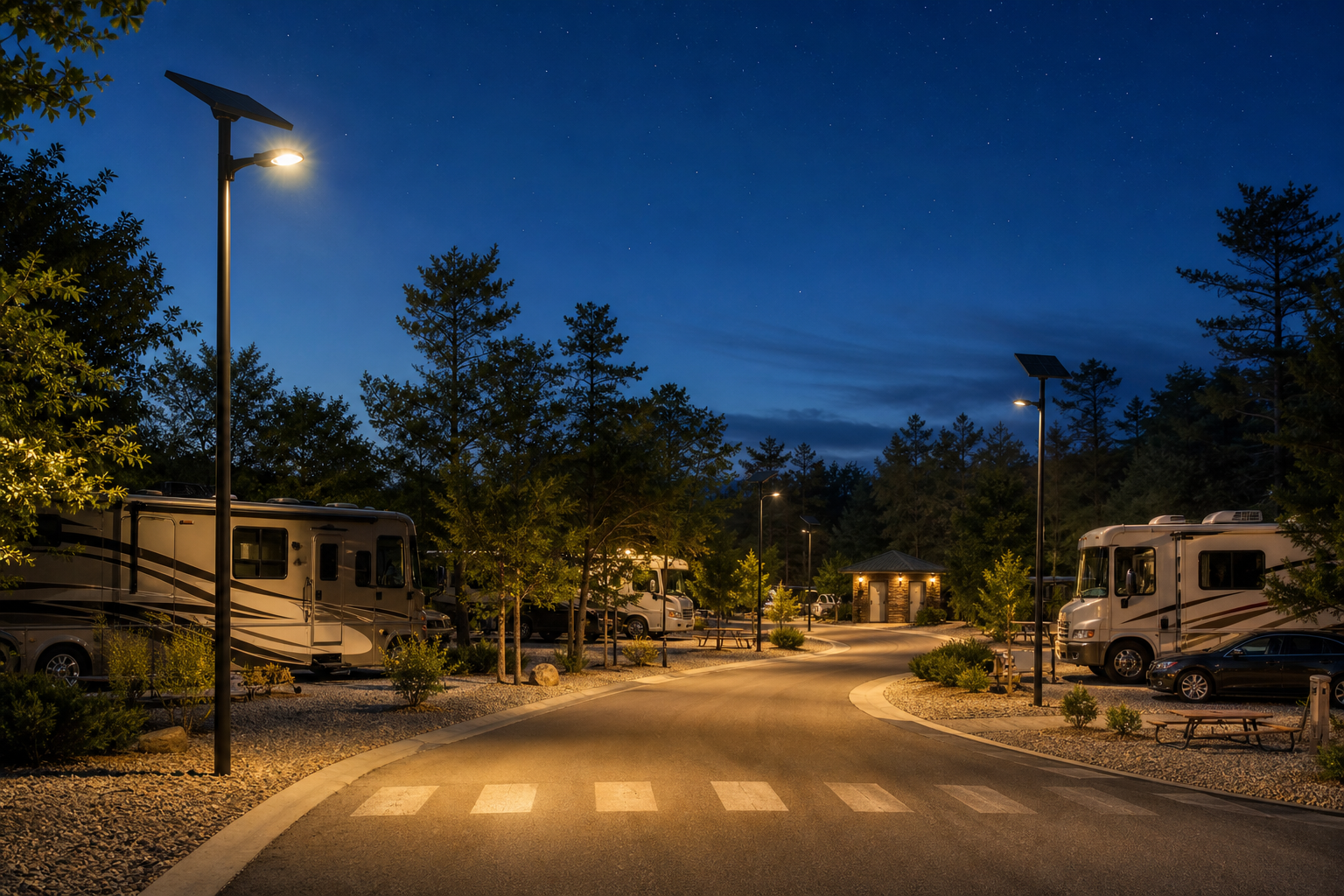
A campground is not a warehouse yard or urban parking lot. People arrive after dark, walk between vehicles and facilities, and navigate unfamiliar roads, yet excessive brightness can disturb sleep, reduce the outdoor experience, create glare, and spread light into surrounding habitat.
U.S. search results use phrases including solar lighting for campgrounds, commercial solar lights for RV parks, off-grid campground lighting, and solar pathway lights for campgrounds. These searches describe several different tasks. A road intersection, a restroom entrance, a pedestrian path, and an individual campsite should not automatically receive the same fixture, pole height, output, or operating schedule.
Start with a plan showing internal roads, check-in, gates, intersections, speed-control points, dump stations, restrooms, laundry buildings, shared facilities, pedestrian routes, maintenance areas, campsites, cabins, trees, and property boundaries. Mark which tasks genuinely require fixed lighting and which can rely on reflective signs, pavement markings, bollards, or guest-carried lights.
The National Park Service outdoor lighting principles recommend first deciding whether a light is necessary, then lighting only the task area with shielded fixtures, controls, the minimum useful level, and warm colors. The NPS explicitly identifies campgrounds, roads, parking areas, visitor facilities, and trails as places where these principles apply.
Dark sky campground lighting is not simply a fixture label. It is the result of fixture shielding, distribution, mounting, output, color, placement, and operating hours working together. A well-shielded luminaire can still create unwanted spill if it is tilted upward or mounted in the wrong location.
The NPS Night Skies guidance recommends purposeful downward lighting, the lowest useful level, timers or motion detectors, and warmer LED light. It also notes that campground visitors commonly carry flashlights or headlamps, so some areas may not need permanent lighting at all.
Ask the lighting designer to review the source from driver, pedestrian, campsite, and neighboring-property viewpoints. Specify shields where needed, avoid visible high-brightness LED sources at normal viewing angles, and keep light away from trees, water, habitat, tents, and RV windows.
Off-grid performance depends on the site, season, and nightly load. A system for an open campground in Arizona is not automatically suitable for a wooded property in Oregon or a winter destination in Colorado. Trees, mountains, buildings, panel orientation, snow, dust, temperature, seasonal occupancy, and long winter nights all affect the design.
The National Laboratory of the Rockies publishes the current PVWatts documentation for location-based photovoltaic production estimates. PVWatts is not an off-grid battery-sizing tool, but it reinforces an essential procurement rule: solar assumptions must be tied to location and weather data.
Give suppliers the project coordinates, shading information, operating months, required nightly schedule, and the number of low-sun days the owner expects the system to support. Request the proposed panel rating, battery chemistry and usable capacity, controller protections, temperature limits, system losses, and energy calculation. Do not accept a universal 鈥渄usk-to-dawn鈥?claim without the associated output profile and design conditions.
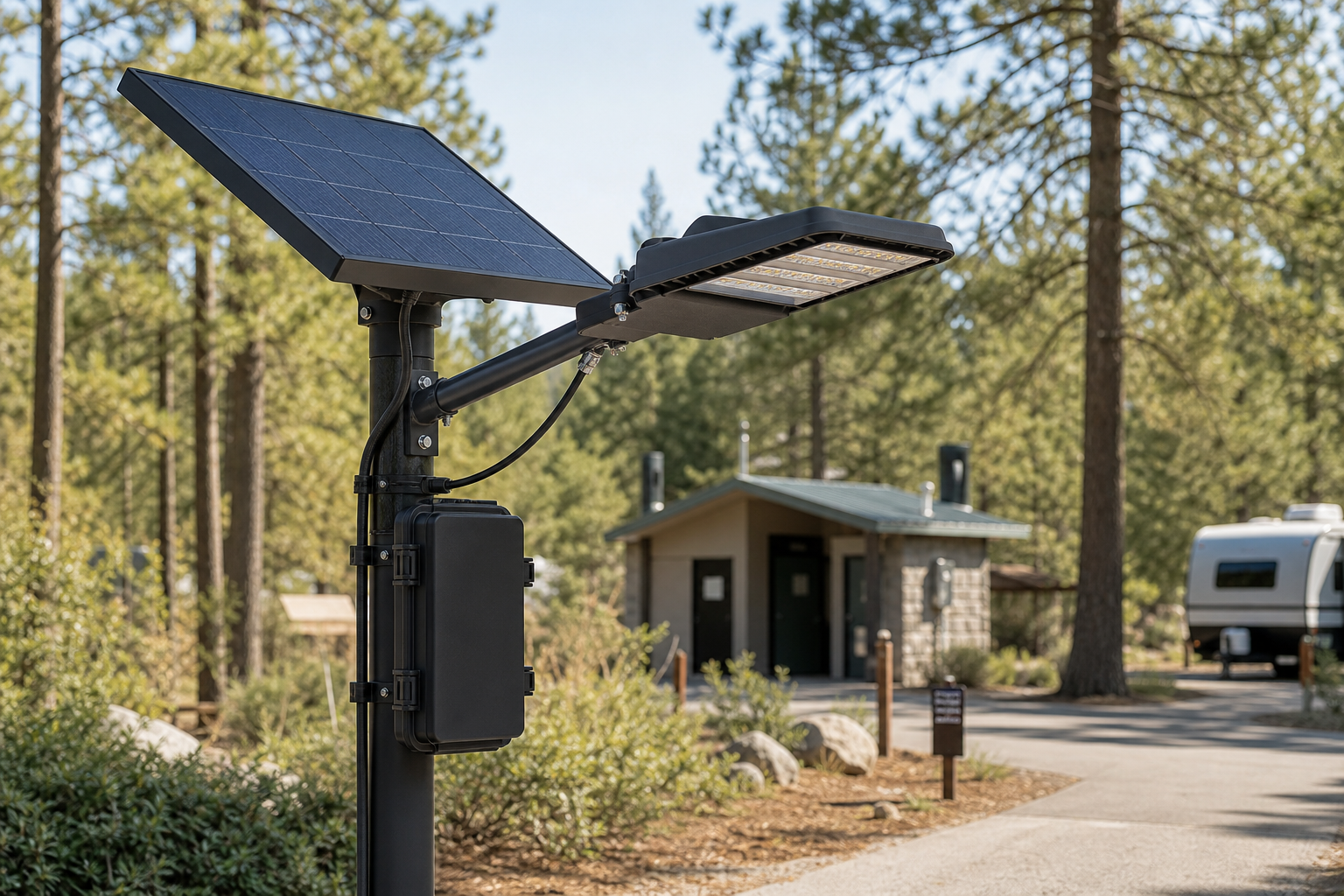
Many RV properties have predictable peaks: evening arrival, quiet hours, early-morning departures, and maintenance windows. Controls can support higher output during active periods and a lower level鈥攐r no fixed light鈥攚here tasks and local rules allow. Motion response may suit selected service or pedestrian areas, but transitions should be reviewed so sudden brightness does not cause glare or disturb nearby guests.
The U.S. Department of Energy's exterior-lighting purchasing guidance emphasizes reliable product data and the energy value of automatic controls. For a solar system, controls also reduce the nightly energy load, which affects panel and battery sizing. Put the schedule in the request for quotation so every bidder calculates against the same requirement.
Do not choose pole spacing by wattage or a generic coverage diagram. Request a photometric layout using the proposed fixture file, mounting height, output setting, tilt, and actual site geometry. Review useful light on the task, uniformity where applicable, glare, spill at campsites and boundaries, and transitions between lit and unlit areas.
Provide road widths, curve geometry, traffic direction, pedestrian routes, pole restrictions, tree canopy, utility conflicts, snow-storage zones, and maintenance access. The result should explain why each pole is needed, not merely fill the plan with a regular grid.
For commercial solar lights for RV parks, the pole carries the luminaire plus a solar panel that adds wind-exposed area. The responsible project professionals should review the location, pole height, panel orientation, mounting hardware, soil or foundation conditions, and applicable wind, snow, seismic, and local code requirements.
Compare sealed housings, cable entries, corrosion protection, fasteners, thermal management, battery access, controller access, and replacement-part availability. Coastal, snowy, humid, dusty, and wildfire-prone regions may create different maintenance priorities. Confirm all required product listings, permits, and approvals with the local authority and project team rather than assuming a generic outdoor rating is sufficient.
Compare complete systems rather than fixture prices. A quote that omits poles, controls, foundations, layout work, freight protection, commissioning, or replacement components may create additional cost later.
Not automatically. The owner and designer should identify real nighttime tasks and conflicts, then use fixed lighting, reflective guidance, markings, or guest-carried light as appropriate for the site and local requirements.
Use the warmest practical light that supports the task and complies with local requirements. NPS guidance favors warm LEDs and notes that sensitive environments may require especially careful spectral choices.
They can in suitable locations, but the detection zone, low-output state, transition speed, guest comfort, required visibility, and effect on nearby campsites should be reviewed before specification.
Send the site location, plan, shading, operating season, nightly schedule, lighting zones, pole constraints, local requirements, control preferences, delivery destination, and expected project timeline.
Guangzhou Vantone Science & Technology Co., Ltd. supplies solar street light, solar LED street light, outdoor LED sports lighting, anti-glare court light, IP65 waterproof outdoor lights, and factory-direct LED lighting. Share your U.S. RV park or campground plan to discuss a zoned solar lighting approach and preliminary system requirements.
