


For developers, contractors, and facility teams, selecting solar street lights for Saudi residential compounds is not simply a matter of comparing fixture wattage. The system must support internal roads, pedestrian routes, entrances, parking edges, and shared spaces through long nights, dust exposure, high daytime temperatures, and changing occupancy. A useful procurement specification therefore starts with the site and the lighting task, then defines the solar, battery, optical, structural, and control requirements needed for reliable operation.
Saudi Arabia's ongoing housing and real-estate development makes disciplined infrastructure procurement especially relevant. The Saudi Vision 2030 Annual Report 2025 describes continued housing and land-development initiatives. That context does not determine a lamp model, but it reinforces why compound lighting should be specified as long-life infrastructure rather than as a stand-alone catalog product.
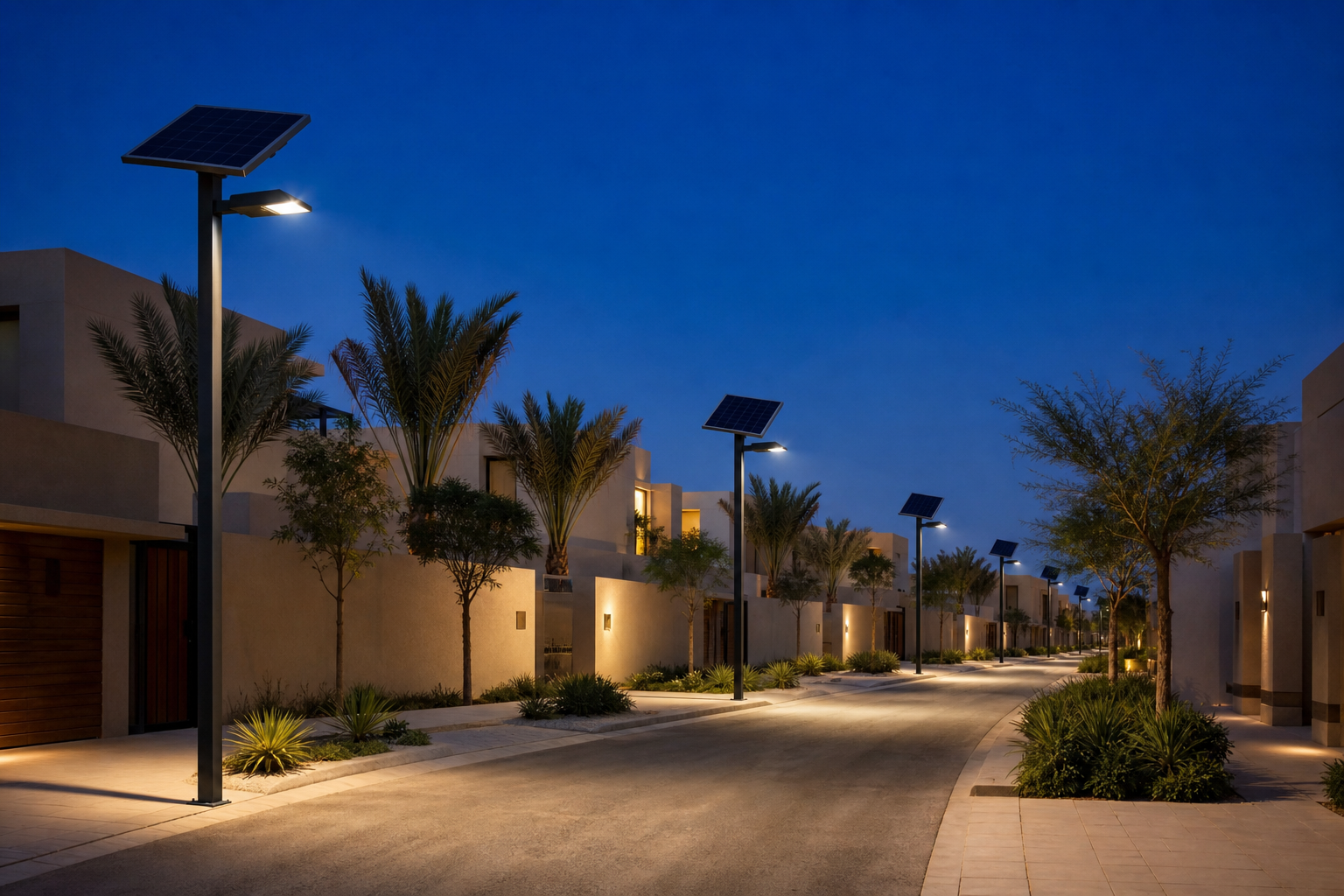
Divide the property into tasks before requesting quotations. A main entrance may need clear facial visibility and vehicle guidance. An internal road needs uniform forward visibility without bright-dark bands. A pedestrian path benefits from lower mounting heights and controlled glare. Parking edges, refuse areas, service lanes, and emergency access routes may each need a different distribution or control profile.
For every zone, record road width, pole setback, mounting height, approximate spacing, operating hours, traffic type, nearby windows, landscape obstructions, and the required dimming behavior. Ask the lighting supplier for a photometric layout based on those dimensions. Luminaire wattage alone cannot show whether the design will produce adequate uniformity or whether residents will see direct glare from windows and balconies.
The electrical load is the starting point for photovoltaic and battery sizing. Define the LED power at each operating stage, the number of hours at full output, dimmed hours, motion-response settings, controller consumption, and seasonal night length. A practical schedule might use higher output during the evening arrival period, reduced output late at night, and a safe programmed level before dawn. The exact schedule should follow the compound's security and circulation plan.
Do not accept a battery capacity or panel wattage without the assumptions behind it. The quotation should show the usable battery energy, permitted depth of discharge, system losses, local solar-resource basis, panel orientation, shading assumptions, and target autonomy. NLR's PVWatts is a useful independent screening tool for photovoltaic resource and energy estimates, although a street-light system still needs an off-grid load and battery calculation from the supplier. Conservative allowance for dust and temperature is more credible than a best-case annual average.
Controlled distribution is usually more valuable than the highest lumen number. Request the relevant photometric file and confirm that the optic places light across the road or path rather than behind the pole or into homes. The U.S. Department of Energy's exterior-lighting procurement guidance emphasizes luminaire performance, recognized photometric testing, and controls. Those principles translate well to international B2B evaluation: compare documented performance and the complete design, not just nominal watts.
Shielding also matters. The U.S. National Park Service outdoor-lighting principles recommend directing light only where needed, using shielded fixtures, applying controls, and avoiding excessive levels. In a residential compound, these practices can reduce discomfort glare, window spill, and wasted upward light. Buyers should request a nighttime mock-up at representative mounting height when a project is large enough to justify one.
Saudi outdoor equipment must be evaluated as an assembly. Ask how the LED driver, controller, battery, seals, cable entries, panel frame, fasteners, and pole interface are protected. An enclosure rating is useful only when the complete installed configuration, including glands and connectors, maintains it. Request operating-temperature ranges for the luminaire, controller, and battery rather than assuming that one headline temperature applies to every component.
Dust can reduce solar input and cover optical surfaces. The maintenance plan should therefore state safe cleaning methods, inspection frequency, connector checks, bolt-torque checks, battery diagnostic steps, and replacement access. Panel tilt and position should permit cleaning without unusual equipment. A supplier should also identify replaceable modules and provide part numbers for batteries, controllers, LED boards or drivers, surge devices, and mounting hardware.
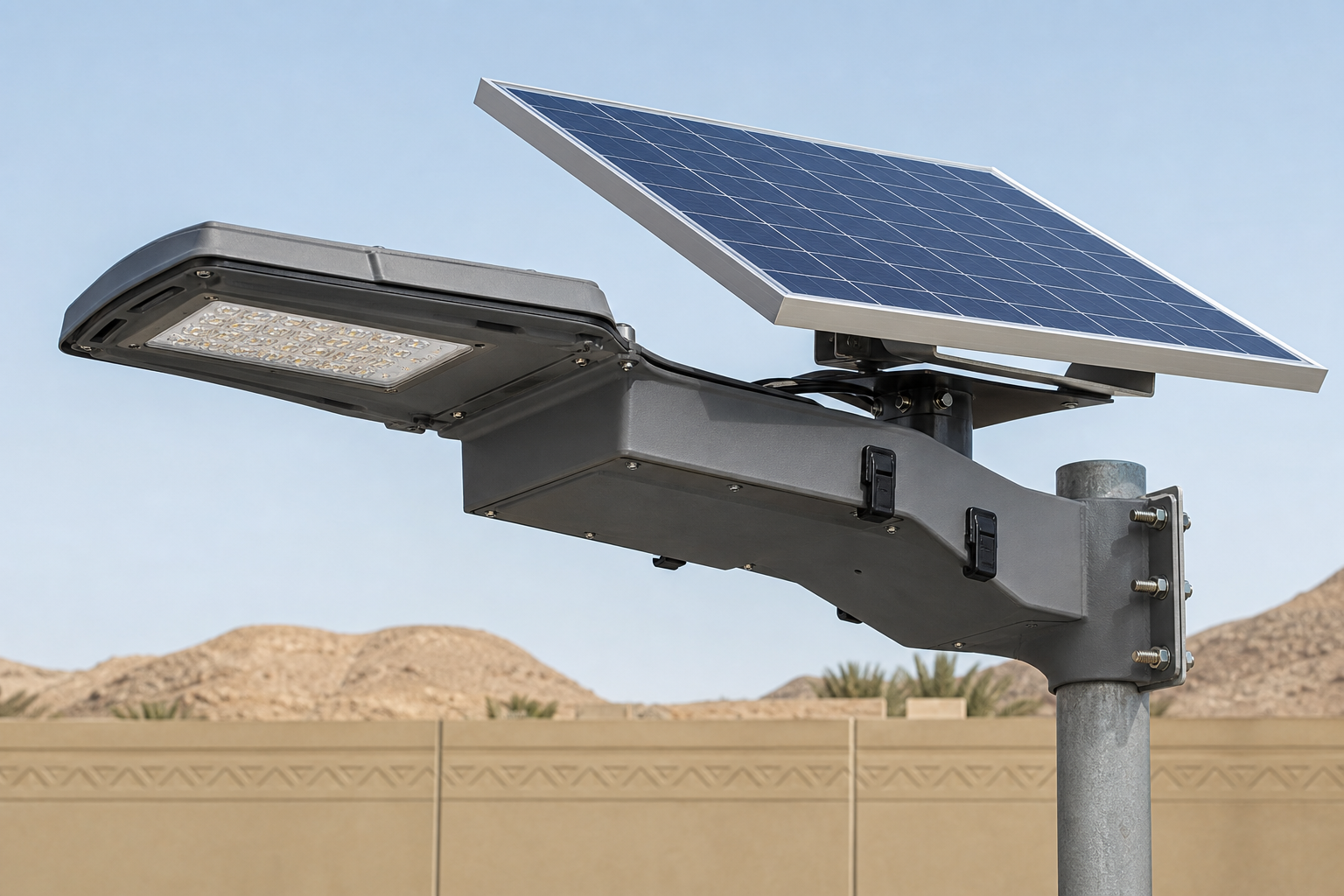
Controls should be written into the schedule, not left as a vague promise of a smart mode. Specify switch-on logic, time-based stages, motion response where appropriate, minimum output, return-to-normal timing, and behavior after several low-charge days. Confirm whether settings are changed locally, by handheld tool, or through a remote platform. If remote monitoring is proposed, ask who owns the account and data, what communication network is required, and what happens if connectivity is lost.
Also specify fail-safe behavior. The controller should protect the battery without creating an unexpected blackout. Buyers should understand low-voltage cut-off, recovery thresholds, fault indicators, and whether a technician can retrieve operating history. For security-sensitive routes, the project team may prefer a guaranteed minimum overnight level over aggressive motion-only operation.
Pole and foundation design must follow project wind, soil, corrosion, and civil requirements. The lighting vendor can provide equipment weights, projected areas, mounting drawings, and bolt patterns, but the responsible project engineer should confirm structural suitability. Avoid generic foundations copied from an unrelated site.
At handover, collect approved drawings, wiring diagrams, controller settings, serial numbers, battery dates, inspection records, photometric files, warranties, spare-parts lists, and maintenance instructions. Conduct a night inspection after final aiming and landscaping. Check dark zones, glare from driver and pedestrian viewpoints, spill into residences, and consistency between poles. Record the accepted settings so later replacements do not change the original design intent.
No. Entrances, vehicle roads, footpaths, parking edges, and service areas have different visual tasks. A coordinated family of products may simplify maintenance, but mounting height, optics, output, spacing, and controls should follow each zone.
There is no universal number. It depends on the local solar resource, criticality of the route, load schedule, seasonal conditions, permitted depth of discharge, temperature, and maintenance expectations. Require the supplier to state and justify the design basis.
No. Excessive or poorly directed light can increase glare and create harsh contrast. Safety-oriented design considers uniformity, shielding, mounting, controls, and the actual task as well as output.
Request project drawings, photometric calculations, the solar and battery sizing basis, component data, control logic, mounting details, inspection criteria, warranty terms, spare-parts support, and a clear commissioning procedure.
Guangzhou Vantone Science & Technology Co., Ltd. supports B2B buyers evaluating solar and outdoor LED lighting for roads, compounds, industrial sites, and public projects. Request a project review with your location, road widths, pole layout, operating schedule, target lighting criteria, and procurement quantity. The team can use those inputs to prepare a clearer system proposal for technical and commercial comparison.
